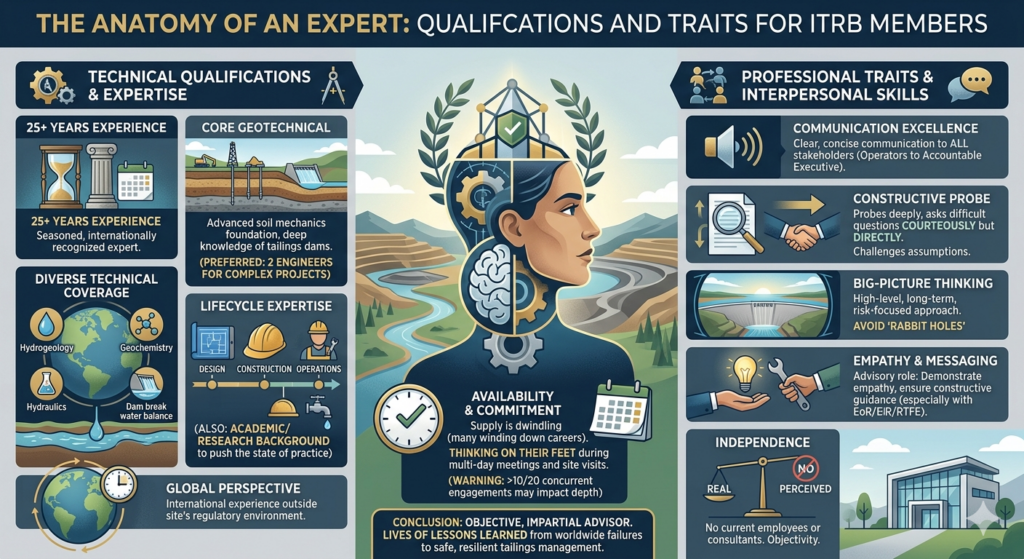
Graphic generated by Gemini, based on the content of this article.
The following article synthesizes the key qualifications and traits of an Independent Tailings Review Board (ITRB) member as outlined in recent industry papers. This article particularly draws on Gerritson et al., Leveraging Knowledge and Experience of a Well-Formed Independent Tailings Review Board to Enhance Tailings Facility Safety, 2023 ICOLD Annual Meeting and Martens et al., Optimizing Independent Tailings Review Boards for Enhanced Risk Management, Proceedings of Tailings and Mine Waste 2025.
As the Global Industry Standard on Tailings Management (GISTM) shifts the Independent Tailings Review Board from a “recommended practice” to a formal requirement, the demand for qualified professionals has increased significantly. An effective ITRB is more than a collection of resumes; it is a carefully assembled group of internationally recognized experts whose technical expertise and personal traits work in tandem to reduce the risk of catastrophic failure.
1. Technical Qualifications and Expertise
ITRB members are typically seasoned professionals with 25 or more years of experience in their respective fields, with exceptions for exceptional individuals. While specific expertise requirements vary by project, a robust board generally includes the following core competencies:
- Primary Disciplines: At least one geotechnical engineer with a deep foundation in advanced soil mechanics is considered a “must-have”. For complex projects, having two geotechnical engineers is preferred, because we all have different backgrounds and areas of expertise.
- Diverse Technical Coverage: Beyond geotechnical engineering, boards often require experts in hydrogeology, geochemistry, governance and hydraulics (specifically for dam break and water balance experience).
- Specialized Expertise: Depending on the site’s risks, members may need experience in seismic hazard analysis, earthquake engineering, or risk assessment.
- Practical Lifecycle Experience: At least one member should have a background in design, construction, and operations to ensure practical oversight. It is also sometimes beneficial to have a member with an academic or research background to push the current “state of practice”.
- Global Perspective: It is recommended that at least one member possesses international experience outside of the regulatory environment of the specific site being reviewed.
2. Professional Traits and Interpersonal Skills
Technical brilliance alone does not guarantee an effective review. The “chemistry” and collaborative ability of the board are crucial to preventing adversarial relationships with the site team.
- Communication Excellence: Members must be able to communicate complex issues clearly and concisely to diverse stakeholders, from on-site technicians to the Accountable Executive.
- Constructive Probing: An ideal member can “probe deeply and ask difficult questions” while remaining direct and courteous. This is essential for challenging the assumptions of the site team and the Engineer of Record (EoR).
- Big-Picture Thinking: Members must maintain a high-level, long-term, risk-focused approach rather than getting lost in “rabbit holes”.
- Empathy and Messaging: Because the ITRB’s role is advisory, members must demonstrate empathy, especially when engaging with the EoR and RTFE, to ensure their recommendations are received as constructive guidance rather than criticism.
- Independence: Members must maintain both real and perceived independence, meaning they cannot be current employees or consultants directly involved with the project.
3. Availability and Commitment
A significant hurdle in the current industry is the “dwindling supply” of experienced members, many of whom are winding down their careers.
- Commitment Check: Some practitioners hold up to 20 concurrent ITRB engagements; however, a member with this level of involvement could be unlikely to provide the depth of review necessary for a high-risk facility, especially if this person has regular employment too.
- Thinking on Their Feet: During site visits and intense multi-day meetings, members must be able to process large volumes of information and provide “in the moment” feedback.
Conclusion
The ideal ITRB member acts as an objective, impartial advisor who brings a lifetime of lessons learned from worldwide failures to bear on a single facility. By combining deep technical specialization with the “soft skills” of team collaboration and clear messaging, they provide the additional layer of assurance necessary for safe and resilient tailings management.