

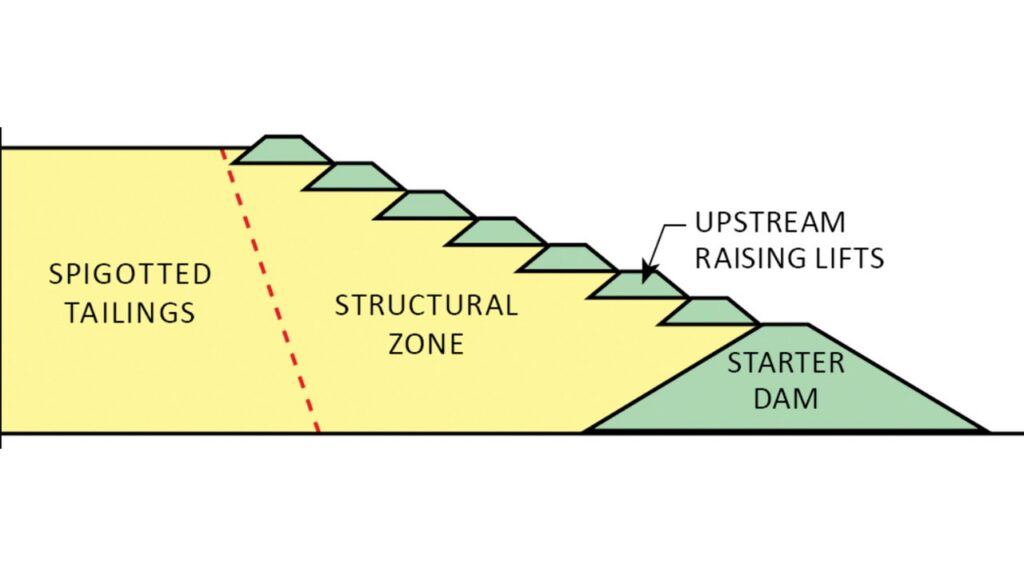
Designing and operating an upstream-constructed Tailings Storage Facility (TSF) is one of the most contentious topics in modern geotechnical engineering. In the wake of high-profile failures like Brumadinho and Samarco, many jurisdictions have banned them entirely.
However, from a purely technical perspective, there are specific “ideal” conditions where an upstream facility can be managed safely. Here is a breakdown of when—and how—it is acceptable to design and operate these structures.
The “Forbidden” Method? Why We Still Talk About Upstream Construction
Upstream construction is popular for one reason: Cost. By using the dried tailings themselves as the foundation for the next lift, you minimize the amount of expensive “borrow” material (like rockfill) needed for the dam.
But this economy comes at a price. Because the dam sits on previously deposited tailings, the stability of the entire structure is dependent on the state of those tailings.
1. The Climate Filter: Arid vs. Wet
The most critical factor for an upstream TSF is the water balance.
- Acceptable: In arid or semi-arid environments (like parts of Western Australia, Chile, or the Southwest US), evaporation rates are high. Tailings can “beach” and desaturate quickly, turning from a slurry into a firm, crusty foundation for the next lift.
- Unacceptable: In high-rainfall tropical environments, the tailings stay saturated. A saturated, contractive tailings mass is a loaded spring waiting for a trigger.
2. The Foundation: Non-Contractive Materials
Upstream dams should only be considered if the tailings are dilative.
- If the tailings are “contractive” (they want to collapse and decrease in volume when sheared), they are susceptible to static liquefaction.
- The Test: You must prove through CPTu (Cone Penetration Testing with pore pressure) that the state parameter is low enough that the material will dilate rather than contract under load. Note that there are a number of approaches that can be used to estimate the state parameter and it is wise to use more than one of these approaches when making your assessment.
3. The Phreatic Surface: Keeping the “Line” Low
In an upstream TSF, the pond is the enemy.
- Acceptable: If the facility has a robust internal drainage system (finger drains, blanket drains) and the supernatant pond is kept far away from the embankment face.
- The Rule: The phreatic surface must be kept deep below the outer slopes. If the water table rises into the outer portion, the risk of a flow failure increases exponentially.
4. Rate of Rise: The “Patience” Factor
One of the most common causes of failure is building too fast.
- To be acceptable, the rate of rise must be low enough to allow for the dissipation of pore water pressures.
- If you stack a new lift before the layer below has consolidated, you create construction-induced pore pressure.
The “Must-Have” List for Acceptability
If you are going to design an upstream TSF today, it must meet the GISTM (Global Industry Standard on Tailings Management) requirements:
- Rigorous Monitoring: Real-time feedback, such as vibrating wire piezometers (VWPs) and InSAR (satellite monitoring) to detect millimeters of movement or centimeter rises in water levels.
- Trigger Action Response Plans (TARPs): Pre-defined “Red Zones.” If a piezometer hits a certain level, corrective measures must be implemented immediately. No questions asked.
- Independent Review: An Independent Tailings Review Board (ITRB) must agree that the design is acceptable.
Summary: When is it Acceptable?
An upstream TSF is acceptable only when:
- The climate is arid.
- The tailings are non-liquefiable (dilative).
- The rate of rise is slow and monitored.
- The phreatic surface is strictly controlled and kept far from the face.
Simply Explained: An upstream dam is like a sandcastle. If the sand is damp and you build it slowly on a solid beach, it stands. If you build it in a puddle while the tide is coming in, it’s only a matter of time before it collapses.