
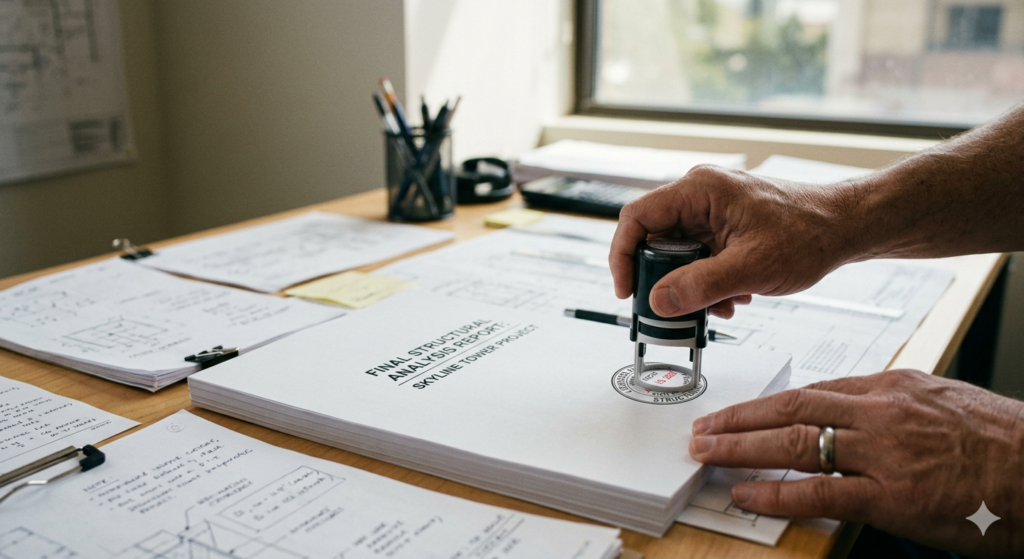
Image created by ai.
For many geotechnical engineers, the title “Engineer of Record” (EoR) can feel like a heavy cloak, draped with liability, responsibility, and the potential for sleepless nights. There’s a common perception that the EoR role is best left to the structural or civil engineers who design the “hard” structures.
But this thinking is not only flawed; it’s actively holding our profession back. Geotechnical engineers are uniquely positioned to excel as Engineers of Record, especially for projects where soil behavior is paramount. It’s time to shed the fear and embrace the stamp.
1. We Design the Foundation of Everything
Think about it: every structure, every road, every bridge, every dam, every tunnel ultimately relies on the ground. A brilliant structural design sitting on a poorly understood or unstable foundation is a recipe for disaster.
As geotechnical engineers, we are the experts in the medium that carries all loads. We understand:
- Soil-Structure Interaction: How the ground and the structure move together.
- Risk Mitigation: Identifying and quantifying the inherent uncertainties of subsurface conditions.
- Long-Term Performance: How groundwater, seismic activity, and time will affect the foundation.
When we are the EoR, we ensure that the entire project, from the ground up, is conceived with a holistic understanding of geotechnical risk.
2. We Speak the Language of Risk
Our profession is inherently about managing uncertainty. We cannot see the ground directly — we infer, we test, and we apply probabilistic methods. This deep familiarity with risk assessment and mitigation makes us uniquely qualified to oversee complex projects.
- Proactive Problem Solvers: We’re trained to anticipate potential ground hazards (settlement, liquefaction, slope instability) before they manifest as costly construction delays or, worse, failures.
- Value Engineering Leaders: Our insights can lead to more efficient foundation designs, optimizing costs without compromising safety.
- Construction Oversight Masters: We understand how construction methods impact ground conditions, allowing us to provide critical guidance during execution.
3. The Buck Stops Where the Geotech Starts
When a project goes wrong, the first question is always “What happened to the ground?” If the geotechnical engineer wasn’t the EoR, there could be a dangerous disconnect. The civil or structural EoR may not fully grasp the nuances of the geotechnical recommendations, potentially misinterpreting or misapplying them.
By stepping into the EoR role, the geotechnical engineer ensures a single, coherent vision for the project’s interaction with the ground. This streamlines decision-making, clarifies responsibility, and ultimately leads to safer, more robust designs.
4. It’s an Opportunity for Professional Growth and Recognition
Embracing the EoR role elevates our profession. It demonstrates confidence in our expertise and demands a broader understanding of project management, legal responsibilities, and client communication.
- Leadership: It positions geotechnical engineers as leaders on multi-disciplinary teams.
- Impact: It allows us to have a greater influence on the overall success and safety of a project.
- Credibility: It builds trust with clients, regulators, and the public, showcasing the critical value we bring.
Don’t Let Fear Be Your Foundation
Yes, the EoR role comes with significant responsibility. But that responsibility is already inherent in our work. We provide critical design input that can make or break a project. The EoR stamp simply formalizes that critical role and empowers us to lead with confidence.
Geotechnical engineers are not just consultants; we are designers, problem-solvers, and risk managers for the most fundamental element of any construction project. It’s time we embraced the full scope of our capabilities and confidently put our stamp on the projects we help build. The ground depends on us.