

If you spend any time working with the Global Industry Standard on Tailings Management (GISTM), you’ll quickly encounter one of the most important and frequently misunderstood concepts in modern engineering: ALARP.
Short for As Low As Reasonably Practicable, ALARP appears in several areas of the standard and serves as a foundational principle for risk-informed decision-making. Yet despite its importance, many engineers, operators, and stakeholders struggle with what it actually means in practice.
Is ALARP simply a way to justify not spending money on additional safety measures? Is it a mathematical calculation? Or is it something more nuanced? The answer lies somewhere in between.
What ALARP Really Means
At its core, ALARP acknowledges a fundamental engineering reality: zero risk does not exist.
Every engineered structure, from a highway bridge to a hydroelectric dam to a tailings storage facility (TSF), carries some residual risk. Materials deteriorate, assumptions prove imperfect, and nature can exceed our expectations.
Because risk can never be completely eliminated, the objective is not to achieve zero risk. Rather, the objective is to reduce risk until further reduction would require sacrifices (in time, money, or resources) that are grossly disproportionate to the additional safety benefit achieved.
In simple terms, ALARP asks, “Have we done everything that is reasonably practicable to reduce risk?”
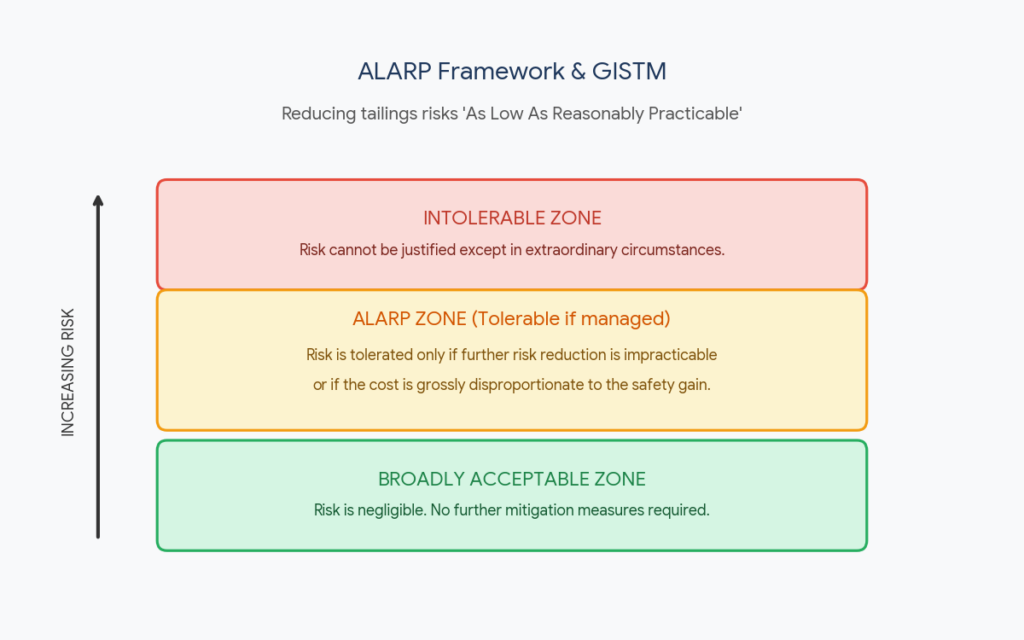
The emphasis is not on what is merely possible, but on what is reasonable when considering technical feasibility, operational impacts, available technology, and the actual magnitude of risk reduction. A useful way to visualize the concept is through three risk regions:
- Unacceptable Risk: Risk that cannot be tolerated. Mitigation is required regardless of cost or inconvenience.
- The ALARP Region: Risk may be tolerated only if further reduction measures are demonstrated to be impracticable or grossly disproportionate to the benefit obtained.
- Broadly Acceptable Risk: Risk is sufficiently low that further reduction is generally not warranted, although monitoring and continual improvement remain important.
Most tailings facilities operate somewhere within the middle region, where engineering judgment becomes critical.
How GISTM Changed the Conversation
ALARP is not new. It has been used for decades in industries such as aviation, offshore oil and gas, nuclear power, and dam safety. What GISTM changed was the level of rigor expected when applying it.
Historically, some organizations interpreted “reasonably practicable” primarily through an economic lens. If a risk reduction measure was expensive or operationally disruptive, it was sometimes dismissed without a comprehensive evaluation of the safety benefit. GISTM shifts the focus toward demonstrating that decisions are supported by a defensible assessment of risk.
1. The Burden of Justification
Under GISTM, operators are expected to understand the risks associated with their facilities and evaluate available mitigation measures in a structured manner. It is no longer sufficient to simply state that a mitigation measure is too costly. The organization must be able to demonstrate why a particular option is not reasonably practicable and why the residual risk remains tolerable. This creates a much higher standard of accountability and documentation.
2. Recognizing the Reality of Legacy Facilities
One of the most practical aspects of GISTM is its recognition that not all facilities begin from the same starting point. Designing a new TSF to modern standards is often more straightforward compared to upgrading a legacy facility that may have been operating for decades under older design criteria.
In these situations, ALARP becomes an essential decision-making tool. It allows operators to evaluate realistic risk-reduction opportunities (such as seepage control improvements, buttressing, enhanced monitoring systems, operational changes, or emergency preparedness enhancements) and determine how best to reduce risk within the constraints of an existing facility. The goal is not perfection; it is demonstrable risk reduction.
3. Executive-Level Accountability
Perhaps the most significant change introduced by GISTM is that decisions regarding tailings risk no longer reside solely within technical teams. Accountable Executives, Independent Tailings Review Boards (ITRBs), Engineers of Record (EoR), and Responsible Tailings Facility Engineers (RTFEs) all play a role in reviewing and understanding the basis for major risk-related decisions. This governance structure ensures that discussions about residual risk occur at the highest levels of the organization rather than remaining buried within technical reports.