

ALARP and Critical Controls: Moving from Strategy to the Field
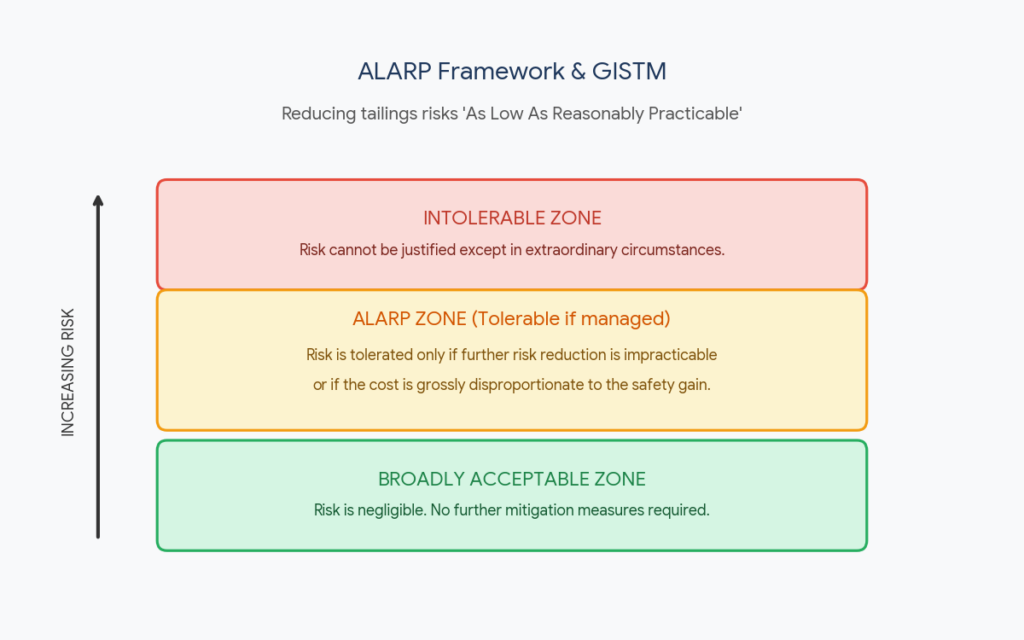
If an ALARP assessment determines what level of risk is tolerable, Critical Controls are the operational muscles that actually hold the line on a daily basis. You cannot legitimately claim a facility’s risk has been reduced to ALARP unless you have identified, implemented, and rigorously monitored the specific controls preventing a failure.
In the context of the GISTM, this relationship creates a continuous safety loop:
- ALARP is the Target: Through risk assessments, you determine that an existing facility is as safe as reasonably practicable, provided that certain operational conditions are strictly maintained.
- Critical Controls are the Guardians: These are the non-negotiable, high-priority safeguards, such as automated vibrating wire piezometers monitoring pore pressure, spillway clearance levels, or daily visual inspections of the embankment toe.
If a single critical control fails or falls outside its predefined Trigger Action Response Plan (TARP) limits, the facility is no longer operating within its verified ALARP state.
Put simply: ALARP is a snapshot of design intent, but Critical Controls are the real-time proof of physical safety. A beautiful ALARP report signed by the Accountable Executive means nothing if the critical controls on-site are neglected.
The Challenge of Uncertainty
One of the most difficult aspects of applying ALARP to tailings facilities is that risk is rarely known with absolute certainty. Engineers routinely must make decisions using incomplete information:
- Subsurface conditions are only partially characterized.
- Future loading conditions contain uncertainty.
- Climate projections continue to evolve.
- Material properties vary spatially and temporally.
- Failure mechanisms may not be fully understood.
As a result, ALARP should not be viewed as a precise mathematical endpoint. It is better understood as a structured framework for making decisions under uncertainty.
The quality of the decision depends heavily on the quality of the information available. This is why ongoing monitoring, performance reviews, site investigations, and periodic reassessments are so important. New information can change the understanding of risk and alter what is considered reasonably practicable.
The Risk of “Paper ALARP”
Like any management framework, it is possible to misapply ALARP. A facility may have extensive documentation, detailed risk registers, and sophisticated reporting systems, yet still fail to address the most important physical risks.
The danger arises when the process becomes more important than the outcome. True ALARP is not demonstrated by the existence of a report. It is demonstrated by evidence that risks have been identified, evaluated, and reduced wherever reasonably practicable. Engineering should drive the decision-making process, not the paperwork.
Increasingly, operators are supplementing qualitative assessments with quantitative and semi-quantitative approaches, including probabilistic analyses, consequence modeling, and formal risk assessments. While these tools do not eliminate uncertainty, they help create a more objective basis for evaluating risk-reduction options.
The Bottom Line
ALARP is often misunderstood as a compromise between safety and cost. In reality, it is better viewed as a commitment to continuous risk reduction.
The principle recognizes that risk can never be eliminated entirely, but it places an obligation on operators to continually ask whether additional reasonable measures exist to make a facility safer. In that sense, ALARP is not about determining what level of risk is acceptable. It is about ensuring that no reasonable opportunity to reduce risk has been overlooked.
For the tailings industry, that distinction may be more important than ever. As facilities age, regulatory expectations evolve, and societal tolerance for failures continues to decline, the most important question is no longer whether a facility meets a baseline standard. The more important question is whether every reasonably practicable step has been taken to reduce the risk it poses to the communities and environments downstream.