

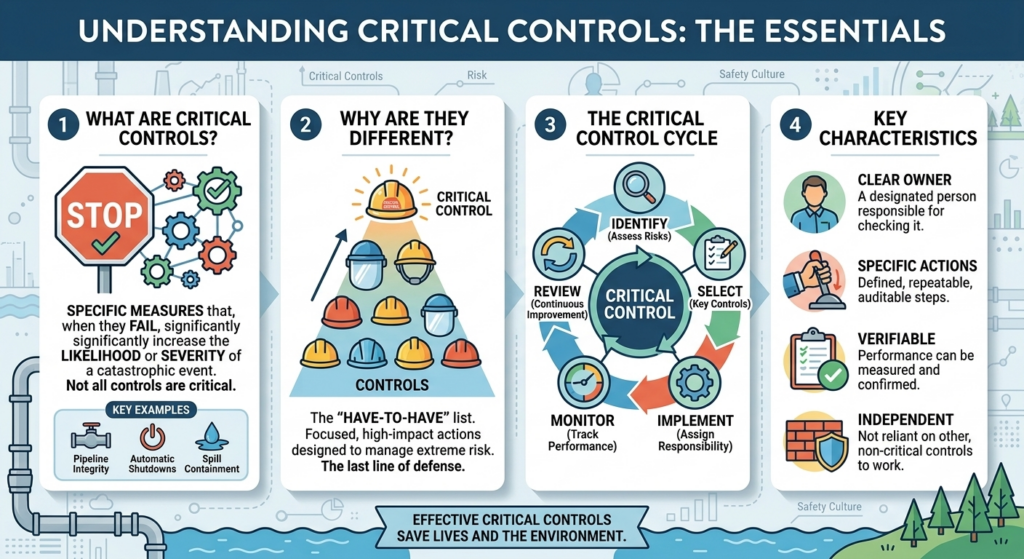
(Graphic generated by ai)
In today’s mining industry, tailings management is often presented through dashboards, risk matrices, audit reports, and governance frameworks. These tools are important, but they can create a misleading impression that tailings safety is primarily an administrative exercise.
A Tailings Storage Facility (TSF) does not fail because of what appears on a dashboard. It fails because water levels rise beyond safe limits, seepage begins eroding internal materials, or an embankment loses stability, for example. Catastrophic failures develop in the field, not in a spreadsheet.
This reality is reflected in the Global Industry Standard on Tailings Management (GISTM), which requires operators to establish a comprehensive Tailings Management System (TMS). Central to an effective TMS is the identification and management of Critical Controls: the safeguards that stand between normal operations and a catastrophic consequence.
If you want to assess whether a mine is genuinely managing tailings risk, the most revealing question is not how many reports are produced or how often audits are conducted. It is whether the facility’s critical controls are clearly defined, monitored, maintained, and acted upon when limits are exceeded.
Understanding Critical Controls
Mining operations employ countless controls to manage day-to-day activities. Traffic rules, inspection checklists, and personal protective equipment requirements are all examples of controls that contribute to safe operations.
Critical controls are different.
A critical control is a safeguard whose failure could directly lead to a major incident or significantly reduce the ability to prevent one. These controls are considered essential because there may be no effective backup if they fail.
Within tailings management, critical controls are typically focused on preventing the primary failure mechanisms associated with embankment dams:
- Overtopping caused by excessive water accumulation
- Internal erosion or piping resulting from uncontrolled seepage
- Slope instability, including structural failure or liquefaction
Because these mechanisms account for many of the most serious tailings failures globally, effective critical controls are designed to monitor and manage the conditions that can lead to them.
Four Fundamental Critical Controls
Although every TSF has unique design features and site-specific risks, most successful Critical Control Management (CCM) programs are built around four core areas.
1. Managing the Phreatic Surface
The position of the phreatic surface, the boundary between unsaturated and saturated material within an embankment, is one of the most important indicators of dam stability.
As water pressures rise within the dam, the strength of the embankment materials can decrease significantly. Elevated pore pressures are a common contributor to instability and, under certain conditions, static liquefaction.
Critical Control: Continuous monitoring of pore water pressures using vibrating wire piezometers and telemetry systems.
Critical Trigger: Pore pressure or phreatic surface elevations exceeding established design thresholds.
Typical Response: Immediate operational review, restrictions on tailings deposition, activation of drainage measures, and engagement of geotechnical personnel.
2. Maintaining Freeboard and Beach Width
Adequate freeboard and beach width are essential defenses against overtopping.
Freeboard provides vertical storage capacity for storm inflows, while the tailings beach helps maintain separation between the supernatant pond and the embankment. Together, they provide critical protection during extreme precipitation events.
Critical Control: Routine monitoring of pond location, pond volume, beach width, and available freeboard through surveys, remote sensing, or visual inspections.
Critical Trigger: Measured conditions approaching or falling below established design requirements.
Typical Response: Increased water management activities, deployment of auxiliary pumping systems, modification of water routing, or changes to deposition practices.
3. Protecting Drainage and Seepage Systems
Properly functioning drainage systems are essential for controlling internal water pressures and safely managing seepage.
When drains become clogged or internal erosion begins, conditions can develop that eventually lead to piping, a failure mechanism capable of undermining the structure from within.
Critical Control: Monitoring seepage flow rates, seepage quality, and drainage system performance.
Critical Trigger: Significant changes in seepage quantity or the appearance of sediment-laden water.
Typical Response: Immediate investigation, enhanced monitoring, engineering assessment, and implementation of corrective measures.
4. Verifying Construction Quality
Unlike conventional structures that are built once, many tailings facilities are raised incrementally over years or decades. The long-term performance of the facility depends heavily on each stage being constructed according to design requirements.
Even small deviations in geometry, material placement, moisture content, or compaction can affect long-term stability.
Critical Control: Construction Quality Assurance and Quality Control (QA/QC) verification during all phases of embankment construction.
Critical Trigger: Failure to meet specified construction criteria.
Typical Response: Suspension of construction activities until deficiencies are corrected and verified.
Turning Data Into Action: The Role of TARPs
Monitoring alone does not improve safety.
A piezometer reading, seepage measurement, or survey result only becomes meaningful when it triggers a predefined response. This is why critical controls must be linked to Trigger Action Response Plans (TARPs).
TARPs transform technical monitoring data into operational decision-making by defining specific actions for predetermined conditions.
| Status | Condition | Required Response |
| Green | Conditions within normal operating limits | Continue routine operations and monitoring |
| Amber | Conditions trending toward a limit | Increase monitoring, investigate causes, notify key personnel |
| Red | Critical threshold exceeded | Implement immediate response actions, including operational restrictions or shutdowns as required |
The strength of a TARP lies in its clarity. When a trigger level is reached, personnel should know exactly what actions are required and who is responsible for carrying them out.
Common Weaknesses in Critical Control Programs
While the concept of critical controls is straightforward, implementation is often challenging. Several recurring issues undermine otherwise well-designed programs:
- Too Many “Critical” Controls
- When everything is designated as critical, nothing truly is.
- Organizations that identify dozens of critical controls often create confusion among operators and decision-makers. Effective programs focus attention on the small number of safeguards that genuinely prevent catastrophic outcomes.
- Lack of Independent Verification
- Critical controls should not rely solely on self-assessment by operational teams.
- Independent review by qualified personnel, such as the Responsible Tailings Facility Engineer (RTFE), Engineer of Record (EoR), or designated reviewers, helps ensure that concerns are identified and addressed objectively.
- Failure to Maintain Monitoring Systems
- Monitoring equipment itself often becomes a hidden vulnerability.
- A piezometer that is not functioning, a survey program that is delayed, or a telemetry system that is offline can effectively eliminate a critical control. Monitoring systems require the same level of maintenance, reliability, and accountability as other essential operational infrastructure.
The True Test of Tailings Safety
The effectiveness of a tailings management program is not measured by the number of reports produced or the sophistication of its dashboards. It is measured by what happens when a critical threshold is reached.
When a Red-level TARP is triggered, does the organization immediately implement the required actions, even when those actions affect production schedules and operating costs? Or does it delay decisions while seeking justification to continue operating? That distinction reveals the difference between genuine risk management and administrative compliance.
Critical controls are more than a regulatory requirement. They are the mechanisms that transform technical knowledge into operational discipline. When properly implemented, they provide the final line of defense against failure and help ensure that tailings facilities remain stable, communities remain protected, and mining operations maintain the trust placed in them.
In the end, tailings safety is not defined by what appears on a dashboard. It is defined by the controls that work when they matter most.